Monday, September 12, 2005

Ford Country Squire Door Panels Replaced!

Clearly, the original Ford Country Squire door panels did not need to be replaced as there were years of reliable service remaining.


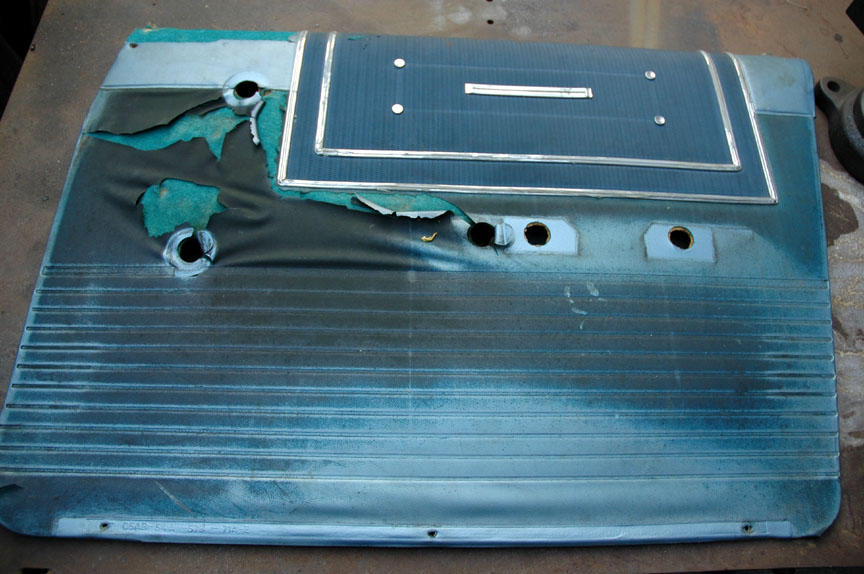
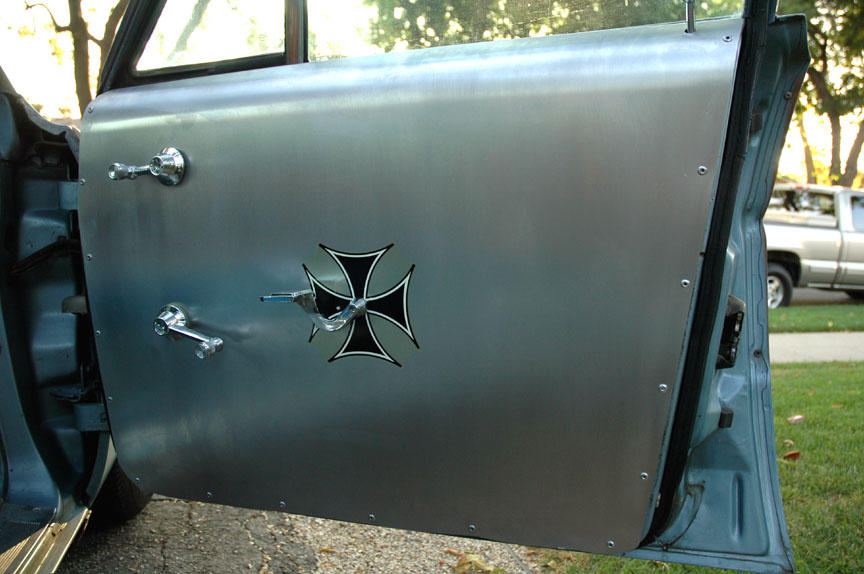
But, I replaced them anyway. This is the passenger door which turned out much better than the drivers door. In other words, I am getting better at it.

Using the original door panels as a model, I trimmed the aluminum panels to the almost correct size by leaving them a little long to anticipate the losses from the roll at the top. Since I do not have a sheet metal slip roll or brake, I was not able to curve the top edge. The local sheet metal shop matched the curve to the original door panel in about 5 minutes and then put a hard edge at the top to hook into the door. I would love to say that the service was great and prices reasonable, but it was not. The sheet metal shop is run by a cantankerous old world bastard. The sort of fellow that has phenominal chops and deep knowledge, but is an arrogant prick that has zero interest in sharing even a few tips while complaining the whole time about how youth has no interest in learning the lost arts. Jerk.

I lined up the panels on the door, marked the material that needed to be trimmed and did the final cuts with tin snips. After lining the edges with weatherstriping, I re-hung the panel and attached the door hardware to hold it roughly in place. Starting at the top, I drilled and riveted my way around the door panel.

Saturday, September 10, 2005

In Praise of Chaucer Vans

Never one to lollygag when there is Photoshopping to do, Coop whipped up this delightful Chaucer van.

Certainly quiets any concerns that a Canterbury Tales theme van might not be a good idea.

Friday, September 09, 2005

In Praise of Custom Vans: Part 1 of 100


Without a shred of hipster irony, I love custom vans. Always have. Since I was a kid. I have spent many valuable hours considering what my future custom van theme will be.

Hot Stuff? With the little mudflap devil and a red crushed velvet interior? A big heart pass-through to the rear bed? A pitchfork shift lever?

Perhaps a Canterbury Tales theme with swords for rear door handles, a Z-Brick interior and bar with gilt mirror spelling MEAD? CHAUCER airbrushed on the side? With the gap-toothed women busting out with a pair of frothy steins?

A TEQUILA SUNRISE van? A round bed and velvet bedspread with dimples like an orange? With a sunset airbrushed overhead? And a minibike on the back bumper? And a tequila filled jerry can with a spigot? Painted to look like a Cuervo label?

Beowulf? Star Wars? Moulin Rouge? Champagne? Old West Whorehouse? I don't mind getting stuck in gridlock traffic as much as some people because there is always a new custom van theme to consider.

Nevada officials apparantly had no qualms about issuing this fellow a RAPER license plate, though they should have arrested him immediately for wearing those shorts.Given the interior space of a van, this guy made quite a commitment with the giant plaster lion. He must have been a big fan of the New York Public Library.
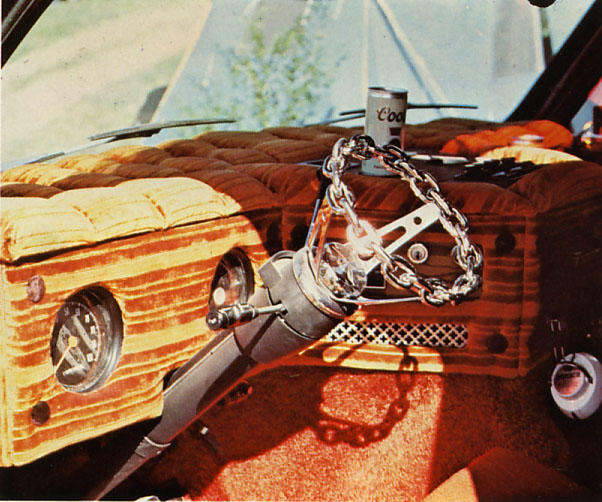
In good faith, you can not deny that this would be fun as hell. Knuckles practically touching on that tiny steering wheel. Listening to Fleetwood Mac on those white headphones. Drinking a Coors in the pre-open container law days. There are only two questions in custom vanning. Ford, Chevy or Dodge? Budweiser or Coors?
Even as a kid, I knew there was something sinister about vans. Who knows what lurks inside? What would John Wayne Gacy drive? The official vehicle of the Mann Act.
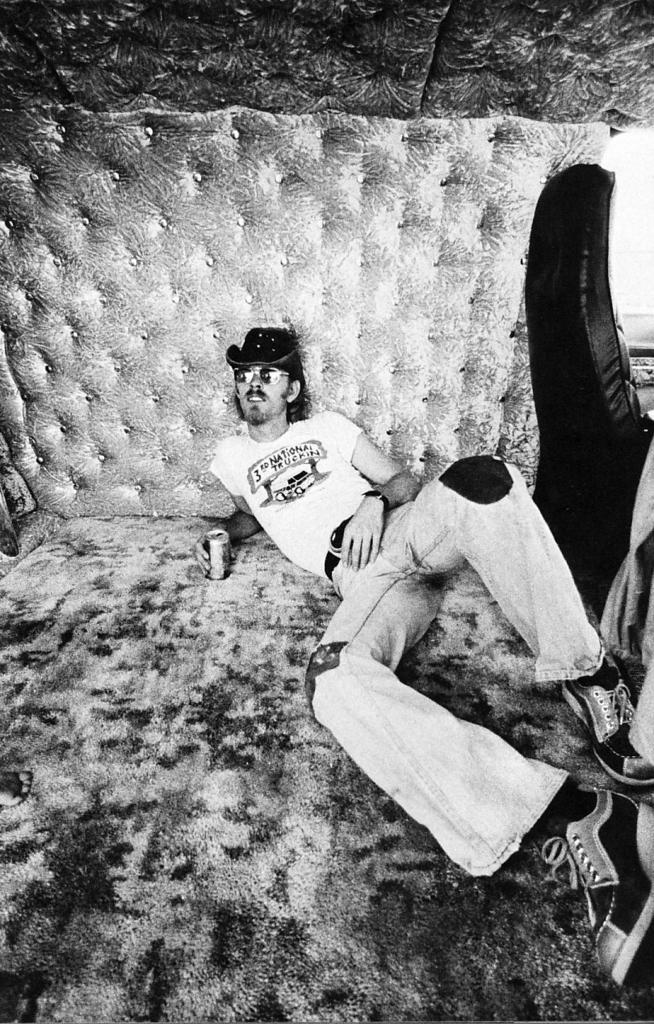
Of course, the reason that guys like this would build a killer van is so they could get chicks. He must have had some incredible van.

Thursday, September 08, 2005

Everybody's asking, 'Did you fix it?'


Sure, I fixed it. The voltage is a little low, but keep in mind the relatively slow idle of a diesel in comparison to a gas engine. As idle was increased, voltage did rise to an acceptible level.

Is that a fancy Fluke 88 V automotive multimeter? Yes, it is. Is it worth the money? Nope. But I am an insufferable snob.

Miracle Mercedes Benz Runs Without Electricity!


I am fascinated by machines that operate without electricity. Powered by individual effort, steam, fuel or gunpowder, there is just something satisfyingly low tech about a machine that operates without the tether of an electrical cord. Clearly, I am of a generation raised with Foxfire books. Naturally, since I collect nearly everything without concern for size or utility, I have sliderules, Curtas, a telephone that operates with a hand crank, a counting machine and this staggeringly beautiful, and back-breakingly heavy, stencil maker. One would think that worldwide demand for stencils has not changed appreciably in the last 50 years, but when was the last time you saw such a machine?

The worst thing about car batteries is notorious leaking of extremely corrosive acid. The battery box on the 1961 Mercedes 190b is literally rusted away. The rest of the car is virtually rust-free but the I am going to have to rebuild the battery box from scratch as currently water pours into the passenger compartment through what used to be the battery tray. Recently, I was thrilled to buy an Optima at a garage sale. This is a true advance in battery design as they are 'gel' based and sealed. They can be mounted upside down and have huge reserve power ratings for the hard cranking diesels.

So, the battery light came on the 1987 Mercedes 300TD and I decided to swap in the Optima. Of course, the battery tray was rusty as hell. I think of the 1987 Mercedes as a new car, but twenty years of slowly leaking batteries told a different story. I removed the tray, wire brushed it and painted it with miracle product POR-15. If you have never used POR-15, you are in for a real treat. It is a rust preventive paint that is thick like molasses and results in a tough as nails coating almost like an undercoating. Complete with brush marks. The instructions for POR-15 ready like a lazy man's best friend. Right there in black and white, they say to not worry about residual rust.


Then I sprayed the tray with Eastwood Trunk Splatter paint because I thought it would be fun. And it was.


Naturally, replacing the battery did not solve the battery light problem. With the modern cars with modern voltage regulators, you can troubleshoot charging problems easily with a voltmeter. People will say, 'Oh, you need to load test the battery! You have to do voltage drop tests between this and that! And do all this other stuff.' Which I suppose is true, but if the battery reads 12.5V with the car off and 12.5V with the car on, it is a damned good bet that the alternator is not charging.


Following my infuriating run-in with the Chevy truck fuel sender, I was prepared from the worst from Mercedes. Admittedly, it would have been nice to buy just those worn-out $3 brushes but things have changed since the time of the Model T. I realize that manufacturer's can not sell every single component in every vehicle and this combination voltage regulator with the brushes replaces the two most common failure points in a single $53 package. Perhaps it is telling that I feel this is a reasonable solution.

Before I got it installed, I had to drive an hour to my mother's house to, among other things, repair the taillights on her Ford Escort station wagon. But, I had a fresh battery and even without the alternator, I thought I could get there and back - if I did not have to use headlights. In case I was wrong, I brought a battery charger but unless a kindly widow let me charge my battery at her quaint farmhouse, I don't know what good it was going to do me. Widows with farmhouse apple pies are getting pretty scarce in Los Angeles.

Needless to say, the battery didn't hold. But it was thrilling! Diesels do not need electricity, per se, to run. To start a diesel requires electricity to turn the starter motor and to warm the glow plugs. But once the engine has started, the residual heat and awesome engine compression enable all subsequent combustion. In theory, this is correct - once running, diesels don't need electricity. But when I was driving, I wondered if it was really true. Would the diesel injection pump require computer controls? No, it is a mechanical system. Would something else need computer control? Would it really run? Probably a line of thinking best pursued from the couch rather than on the freeway, but you know, I am a scientist! Hands on!

And it was amazing. I felt like I was in an Apollo space capsule. You don't generally think of an automobile as having a host of electrical systems, but, boy, once they start failing, you can think no other way! First, the A/C stopped working. Then the fan stopped working. And the dash lights went dim. And the gas gauge quit. The power window barely went down. And the battery warning light went out. There was not enough power to run the battery warning light! But, the car kept running! At 80! I imagine the brake lights were not terribly bright, so, you know, not a great idea. When I got home and turned it off, I tried to start it. Totally dead.

Tuesday, August 30, 2005

Coop's Paint Blogging


If you haven't checked out Coop's site in a while, you should. Totally fascinating blow by blow of a painting coming together. It appears to be alot of work.

Navarro Auction


Recently, I went to an auction to shutdown the majority of Navarro Engineering. Barney Navarro is staying in the hot rod parts business for his flathead head and intakes, but the machine shop was sold and I couldn't miss it. If given the chance, I would have bought the entire shop and left it exactly as it was but these things can't stay as they are. With the exception of a single paperweight flathead that had been ported until there were big holes into the water jacket, there were not a lot of hard car parts. Save the Rambler 6. I bought the stack of wheels. All magnesium, most knock-off style. The set of yellow wheels were on Barney's Indy entry. One of those wheels is marked Ferrari. Who knows how Barney ended up with one Ferrari Grand Prix knock-off magnesium wheel, but there it is. So, I guess I have to build a race car.


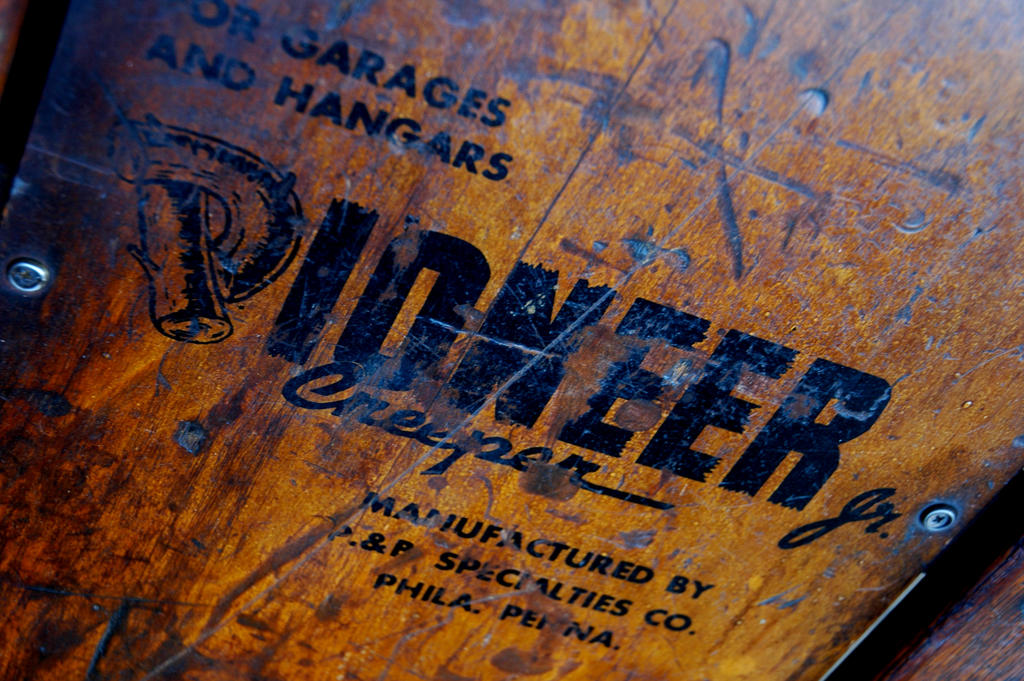
Barney Navarro's creeper has done more, seen more and been under more race cars than I will ever dream about. People at the auction were surprised that I bid up to an astonishing $50 for this beat old creeper, but I figure it is the ultimate hot rod good luck charm.

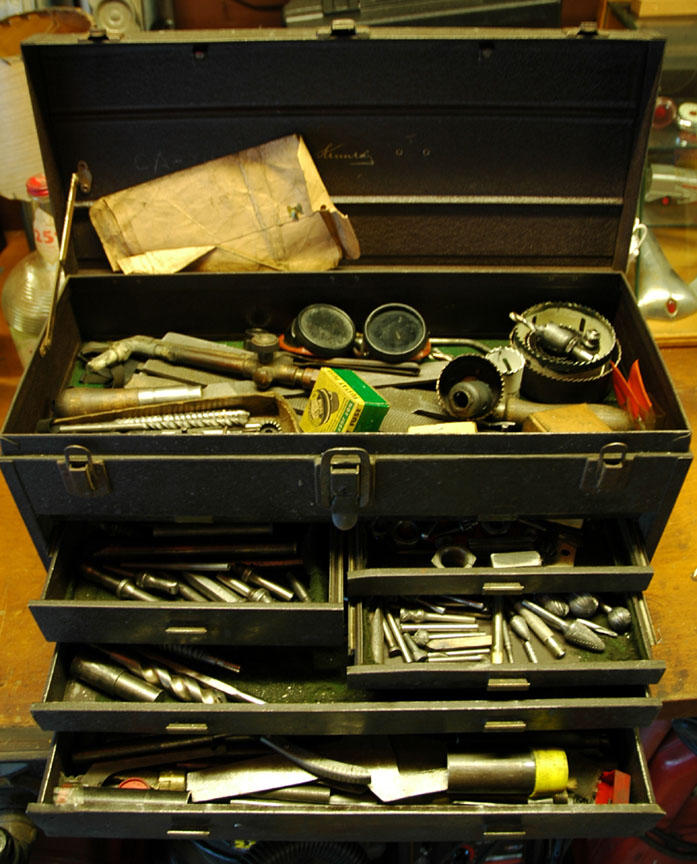
The fellas at the auction were also surprised that I paid about $100 for this toolbox. They asked, 'What was inside?!'

True, a brand new Kennedy machinst box would cost less than I paid for this one, but this is a time capsule. This is a glimpse into the era of the dry lakes racing heros, to a time when an Indy car based on a stock, cast iron Rambler engine could be built in a 2000 sq ft Los Angeles garage. This tool box should be in the Smithsonian. Unless you come across Vic Edelbrock Sr.'s or Alex Xydias toolbox, I don't know that you could find a better box. I would have paid $100 for that 60 year old Victor torch and welding goggles that are sitting in the top. Though I could not buy the entire Navarro shop, I will never add or subtract anything from this toolbox.

What was inside? The history of hot rodding.

Embarassment of Riches


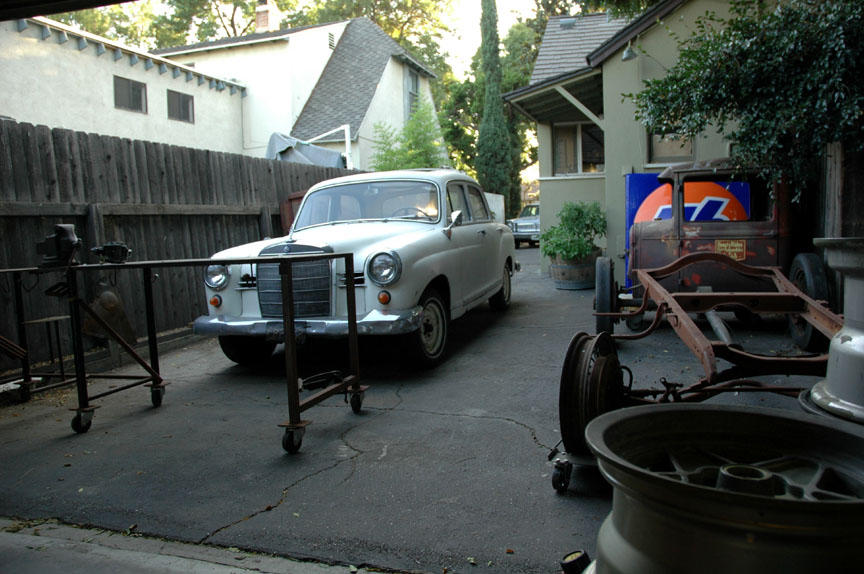
My neighbor's enthusiasm for my projects would best be described as thinly veiled disdain. They feel I have some sort of junkyard and damn right! My junkyard! A suburban junkyard of unlimited potential for the deep pocketed optimist! Perhaps it looks hastily thrown together, but this is the absolute height of organization. The Model A frame and the welding table sit just outside the garage door swingline and, since everything rolls, my work area is instantly reconfigurable for any circumstance. Even my tomato plant whiskey barrel is on wheels to take full advantage of the sun without restricting driveway access. These are times of great abundance - where every average joe can have a junkyard of their own.

Tuesday, August 23, 2005

Hooptyrides Store Coupons


Everybody's asking, when is the Hooptyrides store going to be open so that we show our dedication to the Hoopty cause with our open wallets?

Good question. I wonder, too. Naturally, I am outsourcing cause the internet beats me everytime and the hold up, invariably, is my lack of attention to getting it finished. Once again, I blame the sheer number of projects that I have going. Honest, if lackluster.

Frustratingly, I am piss poor at getting across the look that I am after. With each iteration, I would say, 'More tacky! Cheaper! Garish! Like Bozo's popcorn box under the circus bleachers!' and like any sensible designer - thinking I was intoxicated - they kept returning nicer and nicer work. So, I mocked up this terrific confection! Why I'd buy anything the fellow was selling! Lead me to your snake oil, kind sir!

Sunday, August 21, 2005

No User Serviceable Parts Inside

Everybody's asking, what with the pinball machine, Make welding article and giant ipod, where are the heavy metal, dirty fingernail, gritty car projects for which Hooptyrides became famous? Progress is the natural enemy of having 1000 active projects.

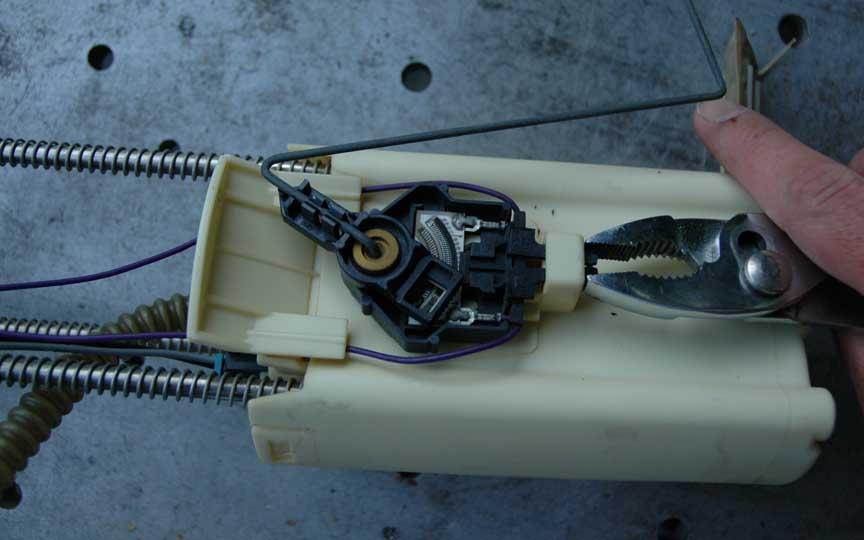
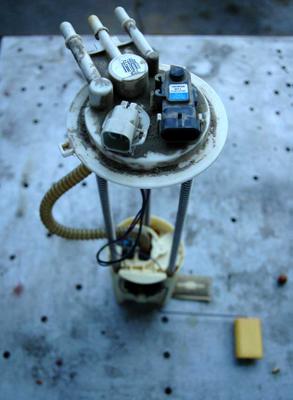
Consider the pictured combination fuel pump/fuel sender unit from a 2000 Chevrolet pickup truck. The gas gauge started acting perquacky and, considering I am a lazy person by nature, I asked the Chevrolet dealership what it would cost to replace. $800. And because I am cheaper than I am lazy, I decided to replace it myself. The part was $500-600 from Chevrolet and $259 from my local auto parts store. For the same exact Delco component. For those that have never had to remove a gas tank from a car, the fuel pump sits inside the tank to pump fuel to the engine while the fuel sender 'sends' a resistance value to the fuel gauge to record tank level.
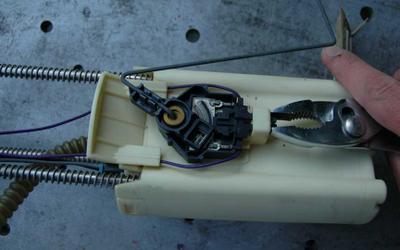

Now, only the fuel sender unit was faulty. The fuel pump still worked like a champion. But you can't buy a fuel sender separate from the fuel pump. It is an integrated component. Looking at the fuel sender, it is clearly designed to be removed and replaced. And to prove my point, I did remove it. It took longer to get the pliers from the toolbox than it did to disassemble.

Sometimes components fail and you have no idea way, but in this case, the cause of failure was obvious. There were two little metal tangs that glided over the PCB resistor contacts and one of them had broken off. This is clearly a component designed for a short life. The metal tangs were very fragile looking and considering they were a) under pressure and b) moved whenever gas sloshed in the tank, it was only a matter of time. Seeing how fine the tangs were, I was surprised to it had not failed earlier. A quick Google search proved I was just lucky that it lasted as long as it had -- it is a very common problem.

So, what happened? I bet Chevrolet specified that the fuel sender unit would be removable. Perhaps they were planning to offer it as a separate SKU. And why would they want to sell it separately? And make less money?

Dale Dougherty wrote a great piece in the current Make considering what makes a product Maker friendly. This is something that I have been thinking about since building the World's Largest Ipod, as I was frustrated that the MacMini is sealed box. The Apple techs open it with some sort of special putty knife. Getting inside an Ipod is even worse. For all the props that Apple gets for their elegant industrial design, would it kill them to put four screws on the bottom? Would that harm the aesthetics so greatly?

With the rise of DIY, hardware hacking and the rise of basement tinkerers, perhaps this is the time to demand our rights to truly 0wn our equipment. It's like DRM. When I pay for things, I want to own them. I won't buy Itunes tracks, because I find it offensive that I need to learn and play by a set of arbitrary rules foisted upon me. Just as I am able to play 8 tracks and 78 RPM records, I know that I will always be able to play a CD, but I don't have that feeling when buying an Itunes track.

Similarly, I hate not being able to get inside my MacMini or Ipod. To not be able to get inside, to not have schematics and to not have the required special tools, is to give up a critical piece of ownership. To be Maker friendly or hacker friendly, also means that you have a servicable platform for repairs.

Mr Giant Ipod used a 1970s Sansui vintage amplifer. It was not by accident. I had originally purchased a garage sale Sony bookshelf system as it was compact, appeared to be in good condition and had all the original manuals. As garage sale risks go, it looked good but it turned out to not work. Naturally, there was no schematic in the manual, so I threw it away. By contrast, every Sansui amplifier I have bought has a manila envelope on the underside marked 'Schematic' and everytime it has had the schematic inside.

So, what does all this have to do with Chevrolet and the fuel sender unit? Obviously, I believe components should be available at a granular enough level to be able to make repairs at reasonable prices. Ideally, you would be able to buy those little metal tangs, but I would be satisfied to just be able to buy the sender unit. But, what really got me riled up? To remove the gas tank required SAE standard AND metric tools! This is not uncommon. I don't think any modern American car is held together with solely SAE standard fastners anymore but it is hard to see a reason for it other than laziness on the part of manufacturer. Don't think GM could specify only SAE or metric?

What would a 0wner's bill of rights look like?

- Metric or Standard, not both
- Fuses accessible from outside the case
- Schematics included
- Housings/cases should be user openable without special tools
- Meaningful parts lists with an order form - instead of just specifying bolt, note the size, thread, etc.
- Special tools should be available - I am not anti-progress or anti-engineering and I recognize smart engineering of new solutions may need new, proprietary tools. The Model T required special tools, but they were included with the car.
- Torx fasteners are ok but unless there is a good reason, tamperproof is not ok
- Replaceable batteries
- Replacement components available that are fix what fails, not more. I.e. fuel sender failure does not necessitate fuel pump replacement
- Helpful information on the circuit board - like commenting code
- Output voltages marked on power transformers
- Never a 'No User Servicable Parts' sticker

Have other ideas? Send em to me. I will blog a new list.

The days of the Color TV tube tester at the drugstore are gone, but why give up control of what we buy?